


URMP Kanpur
Highlights / Unique Features
- Kanpur city in Uttar Pradesh is the first city in India to adopt the URMP framework, to develop a city-specific river management plan.

PARIWAR is an urban water initiative aimed at creating an enabling environment for Water-Sensitive Urban Design (WSUD) in Delhi. A concept popularised in Australia, WSUD integrates the urban water cycle — including stormwater, groundwater, wastewater management, and water supply — into urban design to minimise environmental degradation and improve aesthetic and recreational value.
Conducted in association with Australian experts, the project takes a two-pronged approach: designing and implementing water-sensitive demonstration projects in two disadvantaged communities in West Delhi — Bakkarwala Resettlement Colony and Mubarakpur Dabas Urban Village — and establishing the Delhi Water Forum (DWF), a city-wide, multi-stakeholder body that brings together diverse voices to inform policy decisions for enhancing water security through the WSUD philosophy.
At the city level, the DWF is a first-of-its-kind platform in India dedicated to achieving water security through WSUD, with both government and non-government members onboarded. At the community level, Community Water Forums (CWFs) have been established in Bakkarwala and Mubarakpur Dabas, as well as in surrounding unauthorised colonies, serving as a platform for convergence among local NGOs, Resident Welfare Associations (RWAs), Citizen Action Groups (CAGs), and civic authorities. These forums bridge the gap between disadvantaged communities and local governance while building community capacity through a community-led tree census, skills training in solid waste management, and school-level awareness and monitoring programs.

meetings with the water management line agencies in Delhi
meetings of Community Water Forums in Bakkarwala and Mubarakpur Dabas
Delhi Water Forum meetings
Much of the undesirable state of rivers in the country is because of detrimental activities in cities. While cities have been the main cause of the problem, they need to be part of the solution as well. This project was conceptualised on this premise. The overall objective of the project was to promote river-sensitive urban development in cities of the Ganga Basin. It sought to do so by taking a three-pronged approach. The first was to develop national-level frameworks and advisories for managing the different aspects of urban rivers. The second was to implement pilot projects to demonstrate the application of urban river management interventions. The third was to build the capacities of city officials on different aspects of managing urban rivers.
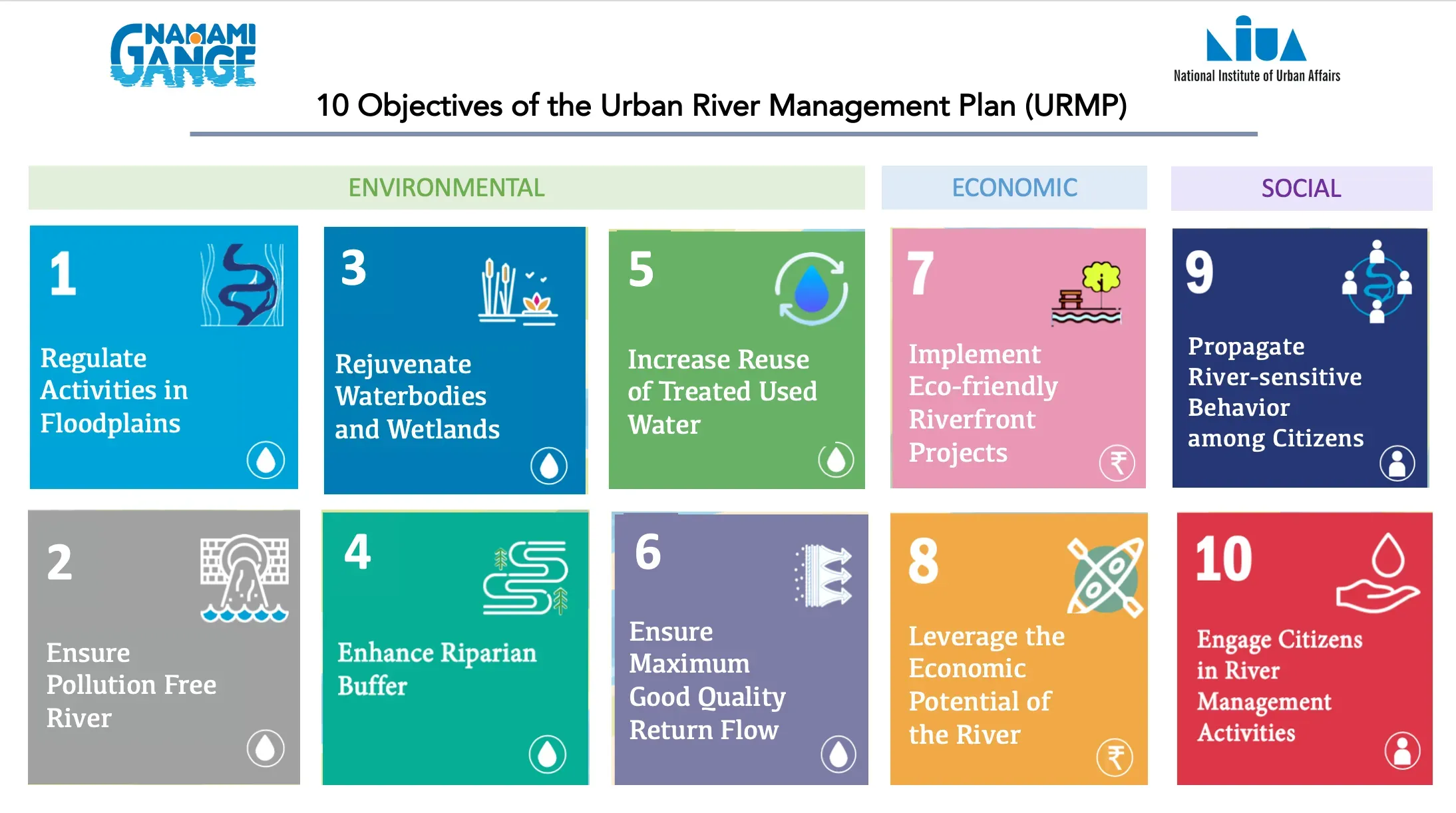
1. Developed a national framework for managing urban rivers called the “Urban River Management Plan (URMP) framework”
The framework is a general template for river cities to prepare their city-specific river management plans. It was launched on 04 November 2020 by the Hon’ble Minister of Jal Shakti. It comprises a 10-point agenda that cities need to act on.
The URMP framework goes beyond mere pollution control to include aspects related to the river economy and to connect citizens with the river. The actions that cities take to implement the URMP framework's 10-point agenda include tangible projects, regulatory measures, planning interventions, and citizen engagement programmes.
2. Established the River Cities Alliance
NMCG and NIUA established the RCA with a vision for long-term conservation and rejuvenation of urban rivers. RCA provides a platform for river cities in India to gain, share, and exchange knowledge on implementing various aspects of managing urban rivers in relation to the URMP framework. It was launched on 25 November 2021 by the Hon’ble Minister for Jal Shakti.
In addition to serving as a knowledge exchange platform, RCA also provides NMCG and NIUA with a unique cohort of cities to mentor and handhold so that they can serve as model cities for urban river management. RCA started with 30 cities but has now expanded to 145 cities.
NIUA serves as the Secretariat for RCA and organises five categories of activities for the RCA members: Capacity building of member cities; networking events for exchange of knowledge among member cities; demand-driven technical support for member cities; expanding the knowledge base on different aspects of urban river management; and documenting and disseminating good practices of member cities within the network and beyond.
3. Developed national guidelines for making river-sensitive master plans
Restoring riverine ecosystems in urban contexts is a multi-sectoral, multi-disciplinary, and multi-stakeholder endeavour. Far too often, cities have a reactive approach to restoration, acting when the problem is already at hand. However, to achieve comprehensive restoration, a proactive approach is needed, one that develops transformational solutions that challenge business-as-usual.
An ideal avenue for germinating such transformational solutions in the urban context is within a city’s broader development plan. The role of urban planning has long been widely acknowledged as a panacea for some of the most pressing challenges; hence, it would be apt to imagine that river-sensitive urban planning is key to reconciling the estranged relationship between rivers and cities.
This document was developed to address this particular need. It focuses on strengthening the symbiotic relationship between rivers and cities through ecologically responsible urban development trajectories.
city officials trained
university student theses sponsored under the first two seasons of the Student Thesis Competition
river cities onboarded to the River Cities Alliance during its launch
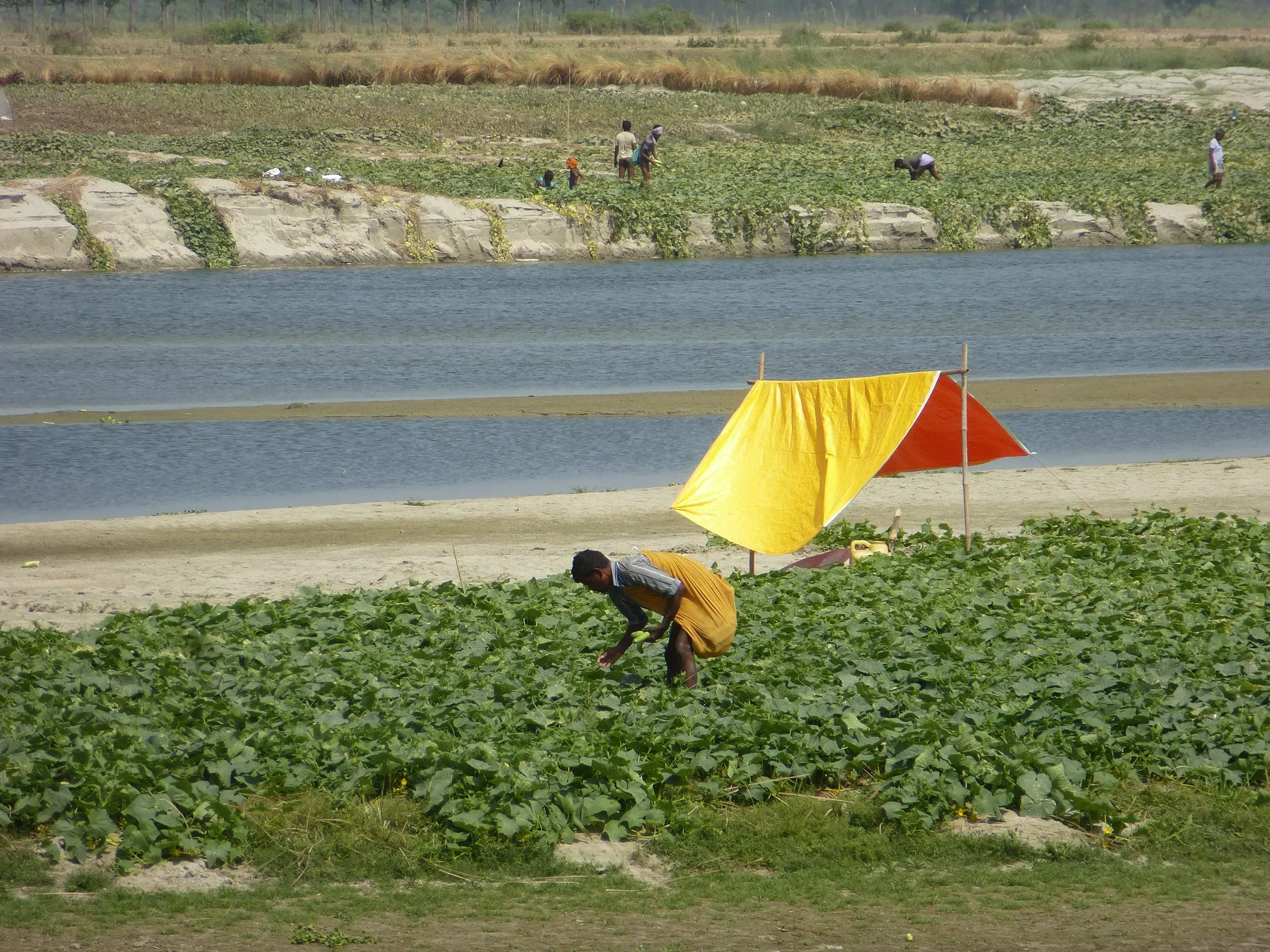
The Ramganga River, a key tributary of Ganga, is a crucial water resource for cities and communities across western Uttar Pradesh. Beyond meeting the region’s water demands, it plays a vital role in supporting the region's economy, particularly in industrial and commercial hubs like Moradabad and Bareilly. However, rapid urbanisation and unregulated discharge of industrial and domestic waste have severely impacted the river’s health, leading to deteriorating water quality and posing significant environmental and public health risks.
To address these challenges, WWF, in collaboration with NIUA, is working on the conservation and sustainable management of the Ramganga River through the development and implementation of Urban River Management Plans (URMPs) for Moradabad and Bareilly.
With support from NMCG, NIUA has developed a comprehensive framework to help river cities plan and implement interventions that restore and maintain urban river stretches sustainably. This framework promotes a multi-stakeholder approach, ensuring better coordination and minimising conflicts among various sectors involved in river management.
By adopting this framework, NIUA has developed URMPs for Bareilly and Moradabad and will work closely with Urban Local Bodies (ULBs) to implement them, fostering long-term river health and resilience.
The URMPs integrate scientific assessments, nature-based solutions, and community engagement strategies. They provide key recommendations for river-centric urban planning and blue-green infrastructure conservation, ensuring the river’s sustainability and resilience.
Multi-stakeholder Workshops conducted
Interventions designed
Ramganga Mitras working for the rejuvenation of Ramganga
The Atal Mission for Rejuvenation and Urban Transformation (AMRUT), launched by the Ministry of Housing and Urban Affairs (MoHUA), aims to enhance urban infrastructure by improving water supply, wastewater and septage management, and developing parks and green spaces in cities. To ensure that projects under AMRUT 2.0 meet quality standards and stipulated project timelines, regular monitoring and evaluations are conducted. These assessments help identify challenges, provide feedback to states and MoHUA, and recommend corrective actions. This process also plays a key role in determining the release of subsequent central fund instalments.
While project feasibility—such as its necessity and viability—is assessed before approval, the Independent Review and Monitoring Agency (IRMA) focuses on evaluating project implementation, identifying obstacles, and facilitating timely interventions.
As part of this initiative, the National Institute of Urban Affairs (NIUA) has been tasked with independently reviewing contract-approved projects across 1,000 Urban Local Bodies (ULBs) in 11 Indian states under AMRUT 2.0. Unlike traditional approaches to assessing infrastructural projects, AMRUT 2.0 integrates third-party independent monitoring through IRMA, ensuring real-time on-site evaluation and necessary course correction for better project outcomes.
AMRUT projects will be reviewed by the IRMA team
Urban Local Bodies (ULBs) will be covered under this review
worth of projects are under evaluation
Most Indian cities rely solely on engineering solutions for water management. However, there is growing evidence that nature-based solutions can serve as significant complementary measures providing multi-functional benefits. In some cases, they have the potential to replace traditional infrastructural interventions. When such solutions are used to address the impacts of climate change, they are called Ecosystem-based Adaptation (EbA).
The overall objective of this project is to create an enabling environment to mainstream the agenda for EbA solutions as a robust and sustainable approach for water management. It seeks to address two core challenges that are faced by most cities grappling with climate change i.e. water scarcity and urban flooding.
The project is being implemented in two phases. The first phase is focused on designing practical EbA interventions for flood control and groundwater recharge in Bhubaneshwar city. The second phase aims to scale up EbA practices within the larger cohort of Indian cities, using the learnings and outputs of the first phase.
Urban ecosystems (Waterbody, Wetland, Urban Green) have been evaluated in Bhubaneswar
Areas were analysed and nature-based solutions were offered to reduce urban flooding
Ecosystems in Bhubaneswar were mapped
India's cities face mounting water challenges — from overburdened supply networks and inadequate sanitation to rising flood risk and fragmented governance. Addressing these demands more than isolated fixes; it requires a holistic, coordinated approach that sees the urban water cycle as a whole.
Integrated Urban Water Management (IUWM) offers exactly that. By treating water supply, sanitation, and stormwater as interconnected systems rather than separate silos, IUWM provides a framework for smarter, more resilient urban water planning. Yet one of the most persistent barriers to its adoption in India has been the absence of a robust, unified data foundation to guide decision-making.
CWIN — the City Water Information Network — was built to change that.
Developed for Gwalior, CWIN is a dynamic, data-driven dashboard that brings together the city's entire urban water ecosystem in one place: water resources, supply networks, wastewater, stormwater systems, the city's Master Plan, and spatial data. It offers real-time visualisation of water-related information, identifies flood-prone zones and groundwater recharge hotspots, maps optimal areas for treated wastewater reuse, and flags communities most vulnerable to flooding. It also highlights opportunities for afforestation and helps municipal officers and planners move from weeks of manual analysis to instant, actionable insight.
More than a tool for Gwalior, CWIN is envisioned as a replicable model — a proof of concept that other Indian cities can adapt as they navigate their own water futures.
Data points for integrated urban water management captured
Groundwater wells inventoried
Cities trained in developing IUWM dashboards
On 10 December 2019, during the National Ganga Council Meeting in Kanpur, the Hon’ble Prime Minister emphasised the need to adopt new thinking in river cities, one with a facilitatory outlook rather than a regulatory approach. In the 5th meeting of the Empowered Task Force on River Ganga in February 2020, NIUA and the Town and Country Planning Organisation (TCPO) were directed to provide suggestions on holistic river-centric planning. Accordingly, the Urban River Management Plan (URMP) framework was conceived of and launched on 4th November 2020 by NIUA in partnership with the National Mission for Clean Ganga (NMCG). The framework is a general template for river cities to develop city-specific river management plans that take into account the ecological and socio-economic significance of rivers. URMPs have since been formulated by Kanpur, Ayodhya, Chatrapati Sambhaji Nagar, Bareilly, and Moradabad.
With support from the World Bank, 60 additional cities within the Ganga Basin states of Uttarakhand, Uttar Pradesh, West Bengal, Bihar, and Jharkhand will now prepare their URMPs. From the hill cities of Uttarakhand to the impact of rapid industrialisation on the rivers of Bihar and Jharkhand, this project will focus on a multitude of verticals - all aimed at strengthening urban river management in India. Over the duration of this project, it will focus on preparing the URMPs in partnership with the 60 identified Ganga Basin cities. In the first phase, 27 cities will be targeted, while the remaining 33 cities will be taken up in the subsequent phase.
Cities in the Ganga Basin states of Uttarakhand, Uttar Pradesh, West Bengal, Bihar and Jharkhand are being covered under the project
People will be directly impacted in the first phase alone, which implements the project in 25 chosen cities
Tributaries of the Ganga River will be impacted in the first phase of the project
The Government of Odisha has been proactively enhancing water supply and sanitation in the state, by operationalizing schemes such as BASUDHA (Buxi Jagabandhu Assured Drinking Water to all Habitation). In August 2019, the state launched its “Drink from Tap” (DFT) Mission that aimed to provide 24X7 drink-from-tap quality water to every household in urban Odisha so that water accessed from household taps was safe to drink and cook with without additional filtration or boiling. In 2021, NIUA was engaged by the Water Corporation of Odisha (WATCO), Department of Housing and Urban Development to evaluate the efficacy of its ‘Drink from Tap’ mission. WATCO has since undertaken this work across 24 Urban Local Bodies (ULBs) in Odisha. NIUA’s role now is to institutionalize an impact assessment framework, using an indicator-based approach to evaluate system efficiency, operations, maintenance, and consumer satisfaction. These efforts include training WATCO officials, applying an easy-to-use impact assessment tool across 24 ULBs, and developing a baseline framework for non-DFT areas to measure the comparative impact and progress of future implementations. Unique features include a blend of qualitative and quantitative data collection methods, rigorous field visits, comparison with Service Level Benchmarks (SLBs), and the creation of a digital dashboard to support macro and micro-level analysis of DFT.
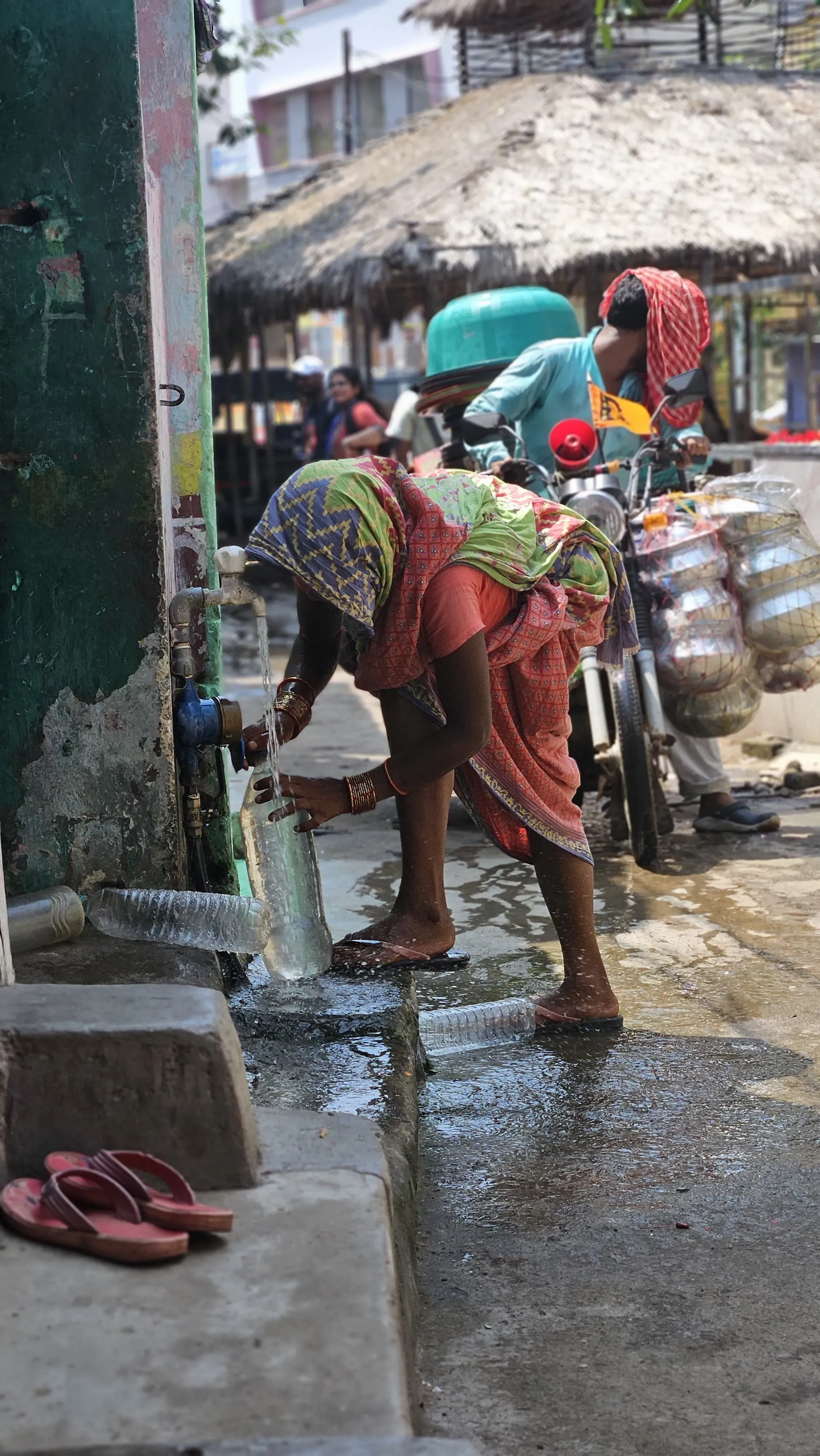
ULBs of Odisha are currently applying the Impact Assessment Tool developed under the project to understand the DFT impact.
household surveys across 21 cities have been conducted to understand the consumer’s perception of, and reaction to, Odisha’s DFT mission.
slum households were surveyed successfully.
The framework is quite unique on several counts.
It uses a systems approach to address environmental, economic and social aspects of river management.
It has been developed as a generic framework that is applicable for any river city in the Ganga River Basin. Yet, the framework allows for city-specific nuances to be captured.
It has been designed to complement and synergize with existing plans and on-going missions in the city.