Workshop Report: Institutionalized an Impact Assessment Framework for Drink from Tap (DFT) Mission in Odisha (PDF)
7.18 MB
Download
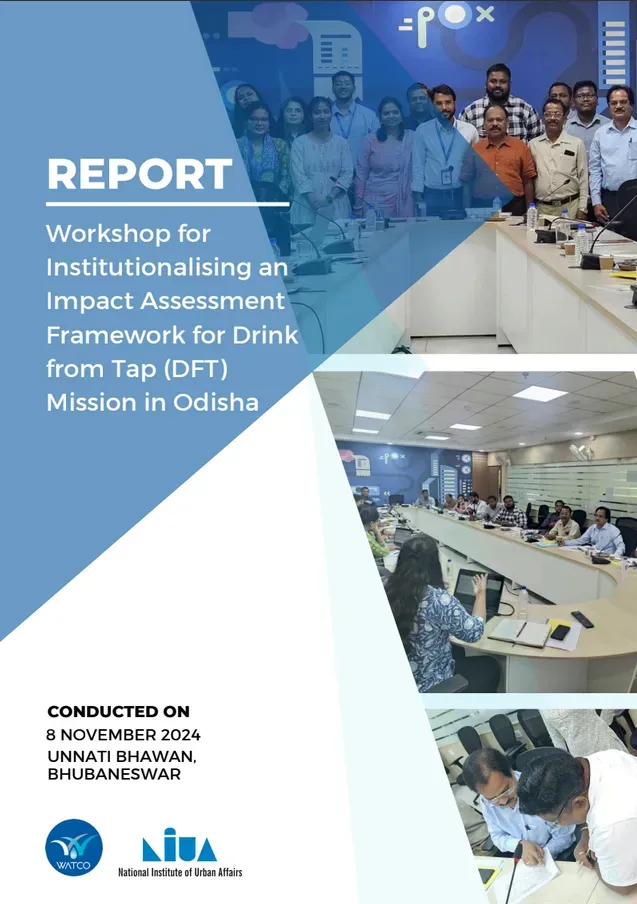
Workshop Report: Institutionalized an Impact Assessment Framework for Drink from Tap (DFT) Mission in Odisha
2024
National Institute of Urban Affairs (NIUA) conducted a workshop aimed at presenting and refining the Rapid Impact Assessment Framework developed for the Drink From Tap (DFT) Mission. The tool has been designed to enable quick, structured evaluation of DFT schemes implemented across 24 Urban Local Bodies (ULBs) in Odisha. The workshop featured the application of this framework in Nimapara, offering practical insights from a recent pilot study. The workshop was organized into four sessions. The first session provided a background on earlier assessment efforts, including comprehensive studies in Puri and Bhubaneswar in 2021. It detailed the methodologies used to establish evaluation indicators and gain infrastructure insights.
In the second session, NIUA introduced the updated 2024 assessment framework, emphasizing three core dimensions: technical performance, operations and maintenance, and consumer perception. The scoring system integrates national and international benchmarks (MoHUA, BIS, WHO, IWA). Data is gathered through service-level benchmarks and a household survey in both slum and non-slum areas. Session three focused on the pilot conducted in Nimapara, where the DFT scheme has expanded to four DMAs. Findings highlighted scope for citywide expansion, improving bill collection, and optimizing energy use. The final session included an open-floor discussion, where WATCO officials provided detailed feedback on refining indicators—such as redefining “unplanned water interruptions” and incorporating complaint types. Officials also suggested including technical gap identification columns and city-level recommendation sheets.
Additional strategic concerns were raised, including staff shortages, WTP capacity alignment, water quality monitoring infrastructure, and the need for demand forecasting mechanisms. Recommendations also included engaging Special Purpose Vehicles (SPVs) for awareness-building and aligning efforts with global standards. The workshop concluded with a positive response from WATCO officers, who appreciated the framework’s relevance and potential. Their insights will guide further refinement, ensuring the tool remains practical, data-driven, and responsive to on-ground realities of DFT implementation.