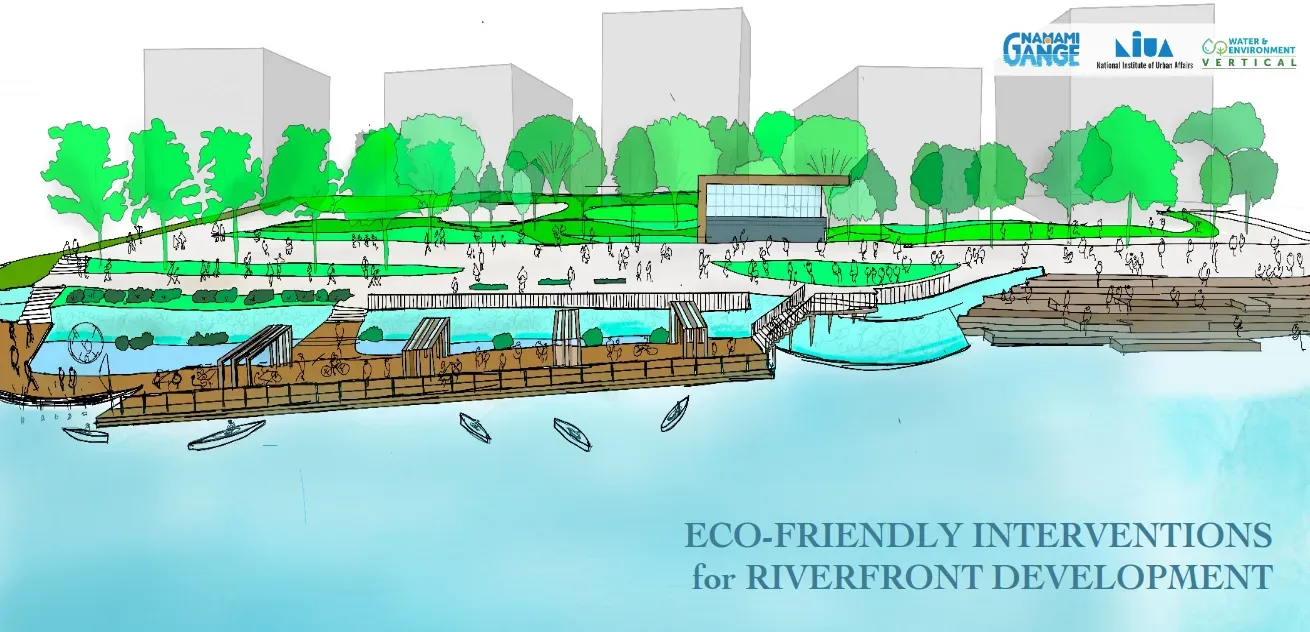
Eco-friendly Interventions for Riverfront Development
2022
The Oxford dictionary defines an urban waterfront as “the part of a town or city adjoining a water body such as a river, lake, harbour, sea, etc.” Riverfronts can take various forms, including riverfronts, lakefronts, canal-fronts, or sea-fronts, often seen in many cities. Historically, riverfronts are where human culture and economies began, with many early settlements developing along rivers. These areas offer a wide range of services, including recreational spaces, intra- and inter-city navigation, livelihood opportunities (such as fishing and agriculture), religious and cultural connections, tourism promotion, and providing open spaces within the city for environmental benefits.
Over time, many urban riverfronts have been neglected, suffering from unsustainable urbanization, pollution, and the impacts of climate change. Most riverfronts have been altered due to poor planning, leading to infrastructure decay and degraded river health. However, these areas hold significant potential for improving urban spaces and quality of life. In response, a need for more robust planning and development has arisen. To develop and regenerate riverfronts effectively, strategies must address several key areas, including ecological restoration, flood prevention, historical and cultural restoration, economic development, recreation and leisure, citizen connect with nature, and livelihood generation.
The development of riverfronts must be environmentally sustainable, ensuring minimal disruption to natural processes, while also fostering social connectivity by strengthening the bond between the people and their river through accessible spaces and cultural engagement. It must also be economically viable, attracting investment, supporting local businesses, and raising property values. Additionally, sustainable design practices and the use of eco-friendly materials are crucial for long-term viability.
Projects like the Sabarmati Riverfront in Ahmedabad serve as good examples of successful riverfront development. This project involved creating biodiversity parks and using organic materials in construction. Miyawaki tree plantations were employed to restore native flora, creating green spaces around the river. Similarly, the Gomti Riverfront in Lucknow used groundwater recharge techniques, sand filters for water purification, and plantation management programs to promote environmental sustainability.
Riverfront development brings multiple benefits. Environmentally, it can help restore natural habitats, enhance biodiversity, and reduce the urban heat island effect. Economically, these projects can stimulate local economies by increasing property values, creating jobs, and promoting tourism. Socially, they provide public spaces for recreation, cultural activities, and community engagement. However, challenges such as the rapid pace of urbanization, inadequate governance, climate change impacts, and aging infrastructure remain. Addressing these requires adopting sustainable development practices, ensuring flood resilience, and involving communities in the planning process.