Integrating Community Participation in Water-Sensitive Urban Futures
The article emphasizes the levy of community engagement in the new paradigm of water-sensitivity in the urban neighbourhood to create resilient, inclusive, and sustainable spaces for all. It highlights how local knowledge, inclusive decision-making, and shared ownership lead to more effective and equitable urban interventions. Demonstrating from the real-life examples and initiatives taken by NIUA in Mubarakpur and Bakkarwala, the article further illustrates how grassroots engagement fosters environmental stewardship and supports long-term sustainability.
11 April 2025
Introduction
Water-sensitive approach is a new paradigm shift to understand the water management of urban India. The unpredictability of meteorological phenomenon and climate concerns have accelerated the imagination and intervention of resilient and sustainable cities. The interconnectedness between resilience and sustainability allows the creation of a habitable space for all and by all. The concept of sustainability envisages the thoughts of the environment, economic and social dimensions of urban life, where the balance between these three pillars is crucial for the long-term stability of urban spaces. This highlights the need to integrate spatial interventions for managing spaces and resources with the principles of social justice and economic viability.
Drawing on Henri Lefebvre’s concept of the "production of space," we understand that urban spaces, including those designed for water management, are shaped through a complex web of social, economic, and political processes (The Production of Space, 1991). David Harvey talks about how all urban residents, particularly the marginalized communities, have the “right to city” — that is, the right to actively shape and access the urban spaces in which they live. Therefore, incorporating community ownership into water-sensitive planning of cityscape recognizes the deep connections between people and the spaces they inhabit. The consideration of social livelihood and economic opportunity within the vision of water-sensitive urban spaces allows the gradual development of resilient and inclusive cities.
What happens when communities get involved?

→ Better projects through local wisdom
Community engagement provides a room of discussion where residents can volunteer their valuable insights into what works for them, what doesn’t, and what’s missing altogether. This helps to avoid the common scenario of well-intentioned but poorly conceived projects that fail to meet the community's needs or, worse, remain unused. This is because the community themselves know their problems better than anyone else. While city planners provide technical knowledge, it is the citizens that provide lived experiences. Their combined understanding helps urban developers and sector experts to plan better and more efficiently.
→ A more inclusive city
Another common threat observed is the disparity in the level of access to decision-making. The vulnerable, destitute, and marginalized communities often struggle with inadequate housing, limited access to clean water, or poor sanitation systems, which are exacerbated when they are not even included in the planning and development processes. Women and the elderly are also usually the least considered population for community engagement. When all groups, regardless of their socioeconomic background, gender, age, or ability, are included in decision-making processes, urban development will become more equitable and accessible.
→ People take care of what they build
Engagement and ownership establish a sense of long term stewardship and collective care towards resources. Empowering communities in the decision-making process of urban spaces allows them to take ownership in designing and managing their own spaces and resources. This not only grants them the authority to shape their environment but also instills a sense of responsibility to preserve and protect these spaces and resources from degradation.
Our efforts in Mubarakpur and Bakkarwala

Under AIWASI, NIUA’s PARIWAR team, in collaboration with Mahila Housing Trust (MHT), World Resources Institute (WRI), and the Department of Foreign Affairs and Trade (DFAT), selected Mubarakpur and Bakkarwala as pilot locations for community-based water sensitivity initiatives.
Mubarakpur Dabas, an urban village on the western periphery of Delhi, consists of local villagers and is surrounded by informal settlements. Bakkarwala, also located on Delhi’s western outskirts, is a resettlement colony. In both locations, NIUA’s team conducted a tree census with active community participation. This data collection process provided critical insights into the existing environmental conditions and helped planners assess potential interventions.

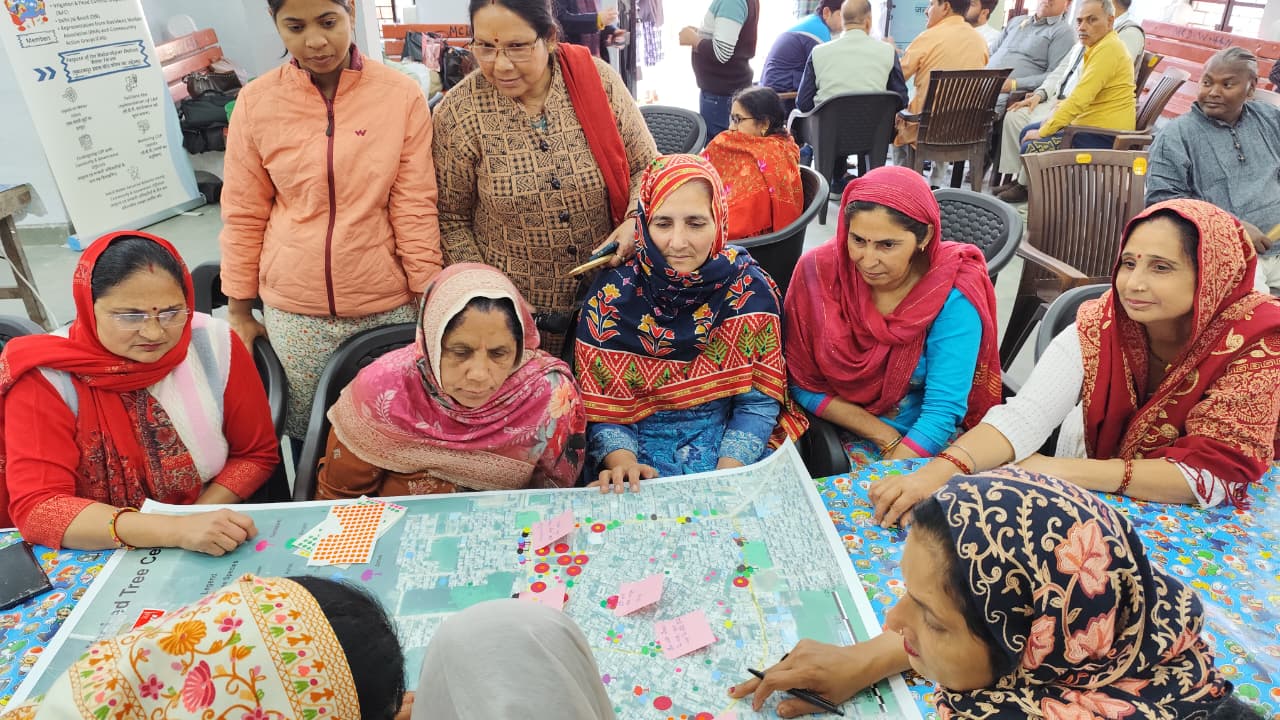
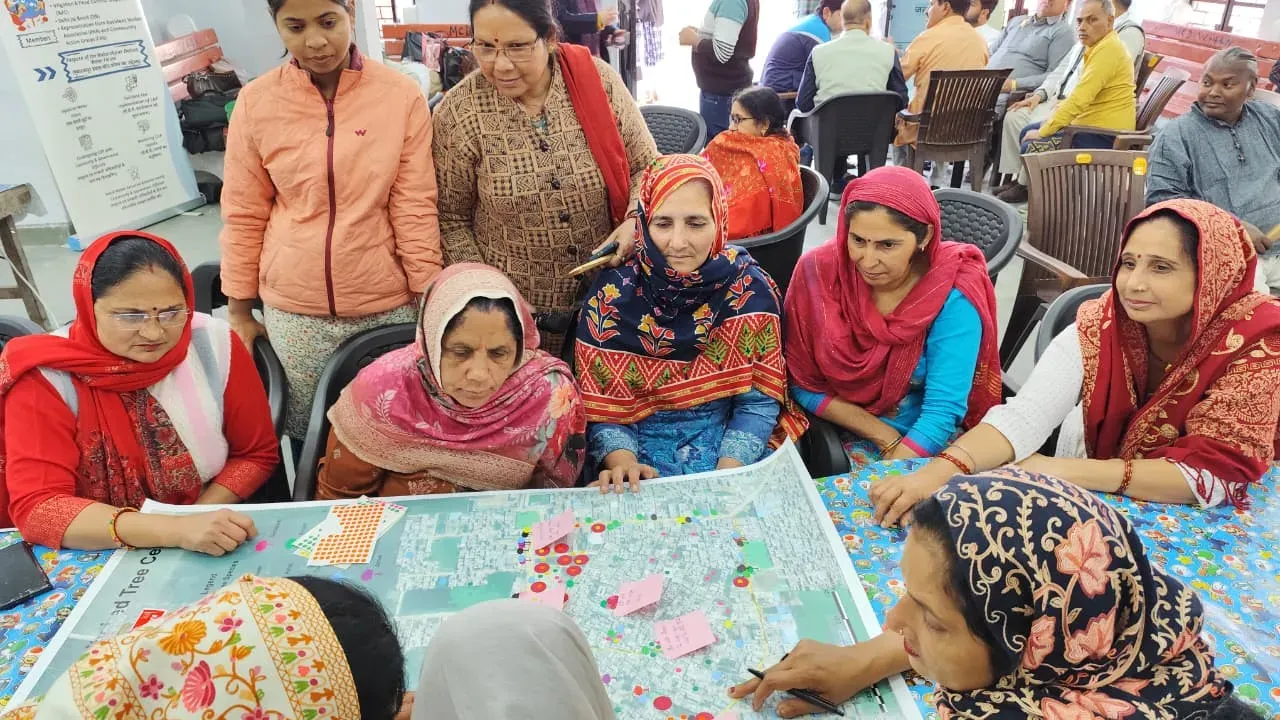
Following the assessment, the team engaged with the community through multiple participatory sessions. During one such engagement, community members shared their preferences and insights, shaping the plantation planning process. The community played an integral role not only in the planning but also in the execution of the plantation drive, fostering a sense of ownership over the newly planted trees. NIUA’s commitment to involving the community at every stage proved invaluable.
By including residents in the initial tree census, the team gathered more accurate and locally relevant data. Their participation in the planning phase provided deeper insights into environmental challenges, such as frequent flooding and the area’s unique ecological conditions. Moreover, involving the community in the implementation stage ensured long-term stewardship of the trees, enhancing the sustainability of the intervention.

Beyond just planting trees, this initiative helped cultivate a more water-sensitive community. By actively engaging in the project, residents became local water champions, fostering environmental stewardship at the grassroots level.
Such community-driven interventions align with the core vision of NIUA’s Water and Environment team, demonstrating how inclusive planning strengthens national development efforts and creates more effective, resilient urban environments.
Author(s)