White Paper: A Qualitative Framework to Evaluate the Extent of Integrated Urban Water Management in Indian Cities & Applying the Framework to Delhi (PDF)
8.72 MB
Download
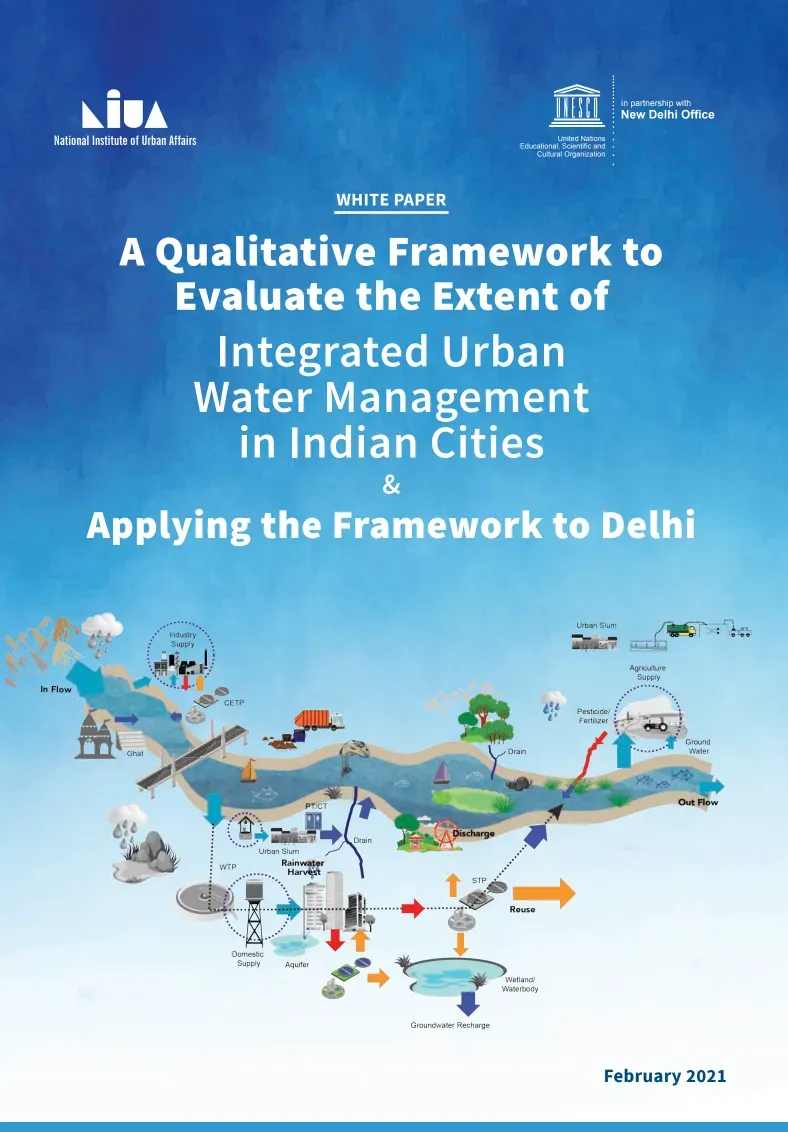
White Paper: A Qualitative Framework to Evaluate the Extent of Integrated Urban Water Management in Indian Cities & Applying the Framework to Delhi
2021
Integrated Urban Water Management (IUWM) has emerged as a widely recognised philosophy for managing the urban water sector, advocating a holistic treatment of water supply, wastewater, and stormwater systems to strengthen urban water security. While India has acknowledged IUWM as a sound and robust approach since 2015, its adoption has remained limited — constrained by gaps in awareness, the complexity of translating philosophy into practice, and the need for a nuanced understanding of a city's water dynamics across hydrological, economic, institutional, governance, and social dimensions.
This White Paper seeks to bridge that gap. It presents a qualitative framework comprising ten criteria — organised under three heads: enabling environment, institutional arrangements, and management instruments — designed to help cities assess the extent of IUWM implementation and identify priority areas for progressive advancement. Conceived as an introspective instrument, the framework is intended to support honest internal assessments rather than inter-city benchmarking or comparison.
The framework is subsequently applied to Delhi, India's capital city, to evaluate its current standing in terms of IUWM adoption. The assessment reveals that Delhi possesses a strong enabling environment, underpinned by progressive policies and a robust financial position. Its institutional arrangements are largely adequate, with dedicated agencies managing distinct elements of urban water management, though inter-agency coordination remains an area requiring improvement. On management instruments, Delhi presents a mixed picture — deploying advanced interventions such as District Metering Areas, trenchless sewer remediation, and centralised water data systems, while falling short on citizen engagement and preventive or transformational research aligned with IUWM principles. Overall, the city's extent of IUWM implementation is assessed as moderately good, with significant potential for improvement.
By establishing a structured and replicable evaluative framework, this Paper aims to stimulate critical thinking among water managers and decision-makers, laying the groundwork for targeted action and enhanced urban water security across Indian cities.