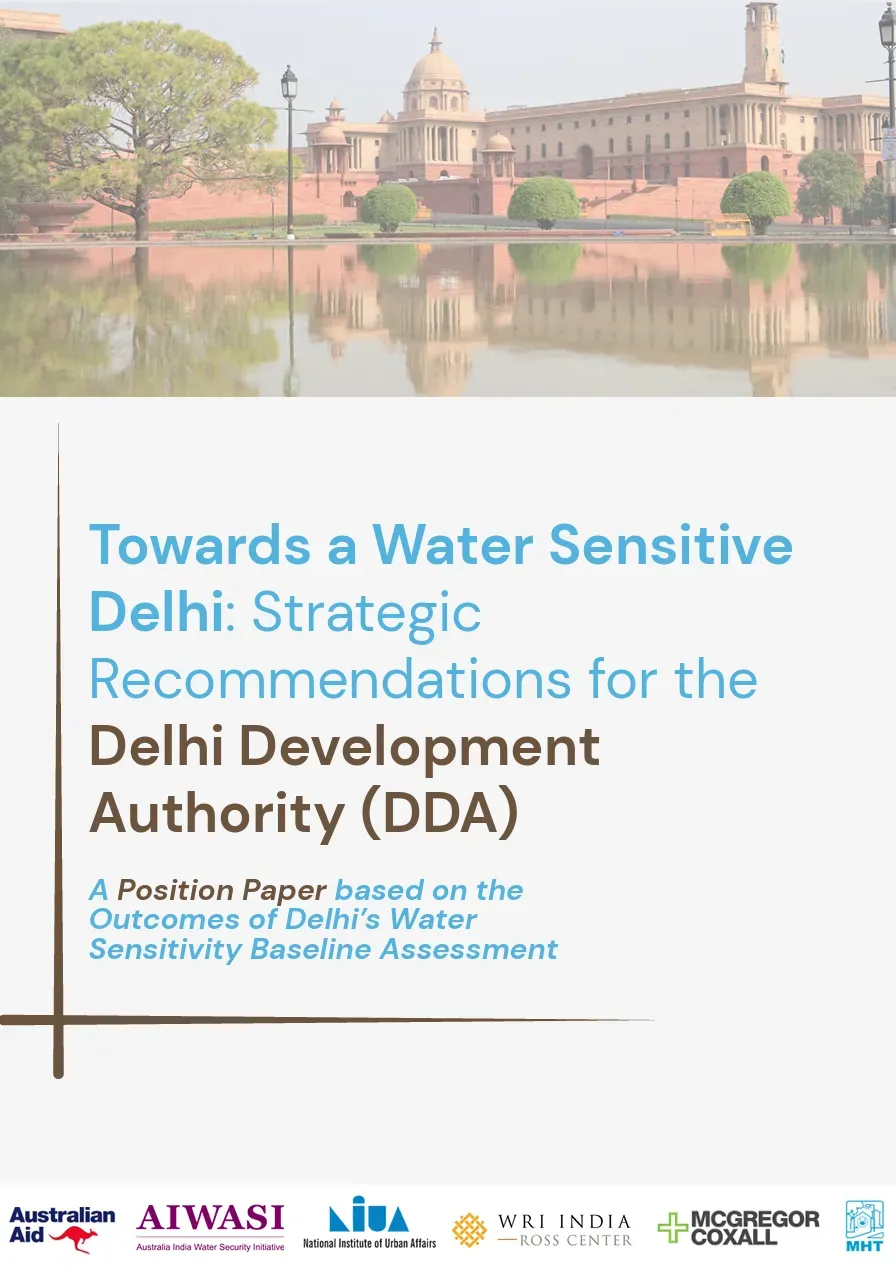
Towards a Water Sensitive Delhi: Strategic Recommendations for the Delhi Development Authority (DDA) (PDF)
3.7 MB
Download
Towards a Water Sensitive Delhi: Strategic Recommendations for the Delhi Development Authority (DDA)
2025
This Position Paper is an outcome of the Australia-India Water Security Initiative (AIWASI), led by the Department of Foreign Affairs and Trade (DFAT), Australia, and implemented through a consortium comprising the World Resources Institute (WRI), the National Institute of Urban Affairs (NIUA), the Mahila Housing Trust (MHT), and McGregor Coxall (Australia). The Initiative seeks to advance the adoption of water-sensitive planning and design principles within the Indian urban context.
Informed by the Delhi Water Sensitivity Baseline Assessment — which evaluated Delhi's performance against the seven goals of the Water Sensitive Cities Index, as conceived by the Cooperative Research Centre for Water Sensitive Cities (CRCWSC), Australia — this Paper identifies the city's current standing in urban water management and delineates critical areas requiring targeted intervention.
The Paper is specifically intended to guide and support the mainstreaming of water-sensitive planning and design principles within the operations and institutional vision of the Delhi Development Authority (DDA) — the apex body responsible for planning and development in Delhi. As the custodian of approximately 5,050 hectares of green cover, 15 sports complexes, 429 local shopping centres, 7 district centres, and several urban heritage sites, and as the preparing authority for the Master Plan for Delhi — the city's 20-year development roadmap — the DDA is uniquely positioned to drive this transition at scale.
Developed through extensive consultation with members of the Delhi Water Forum — a multi-stakeholder platform established under AIWASI, bringing together six key government line agencies, think tanks, academic institutions, community-based organisations, and subject matter experts — this Paper reflects a broad, inclusive, and governance-informed perspective on pathways toward a water-sensitive Delhi.