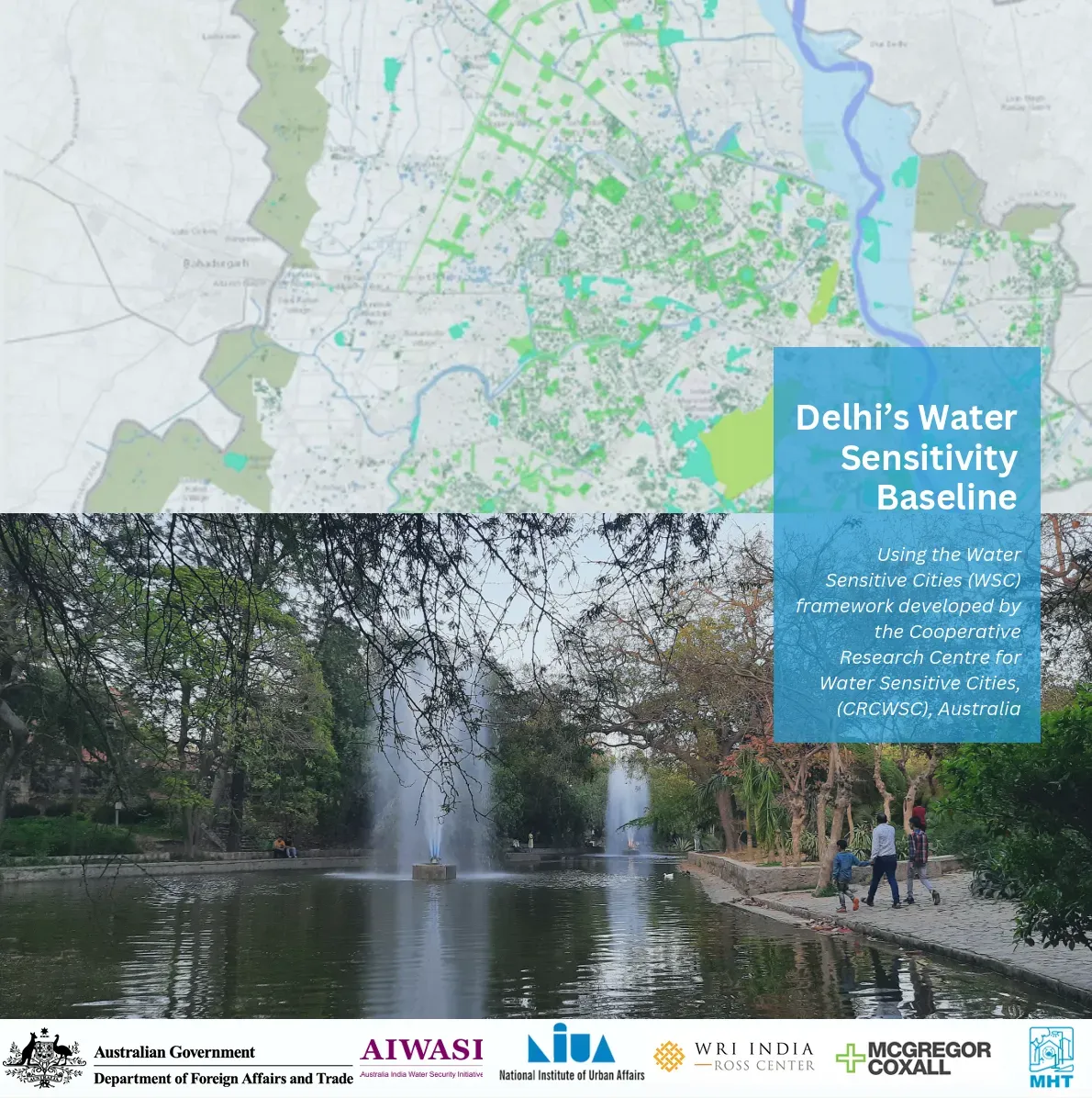
Delhi's Water Sensitivity Baseline
2025
Delhi is confronted with escalating and interconnected water challenges that demand urgent, structured attention. The city faces a daily water supply deficit of 260 MGD against a total demand of 1,250 MGD, with groundwater extraction persisting at unsustainable levels of 126 MGD. Its drainage infrastructure — comprising over 4,000 drains — has become severely fragmented, with only 700 distinctly identifiable, and 19 major natural drains documented in the 1976 Drainage Master Plan no longer in existence. Urban water bodies have recorded a 7% reduction in area between 1999 and 2012, and the Yamuna River, though entering Delhi in a relatively unimpaired condition, exits as one of the most polluted stretches in the region. These conditions reflect the cumulative consequence of rapid urbanisation and the absence of an integrated, water-centred approach to urban planning.
The Delhi Water Sensitivity Baseline presents a systematic assessment of the city's current standing across key dimensions of urban water management. Drawing upon the three-pillar framework articulated by Rogers et al. — which positions cities as catchments, recognises them as ecosystems, and emphasises the development of water-sensitive communities — this document evaluates Delhi's existing strengths, identifies critical gaps, and maps opportunities for targeted intervention.
Establishing this baseline constitutes a foundational step toward informed, evidence-based decision-making. Given the long-term and iterative nature of a water-sensitive transition, this assessment is intended to guide policymakers, urban planners, community representatives, and other key stakeholders in prioritising action, bridging governance and knowledge deficits, and shaping policies that advance Delhi toward a resilient and water-sensitive future.